 +506 72407140
 info@beitshalomcr.org
 Donaciones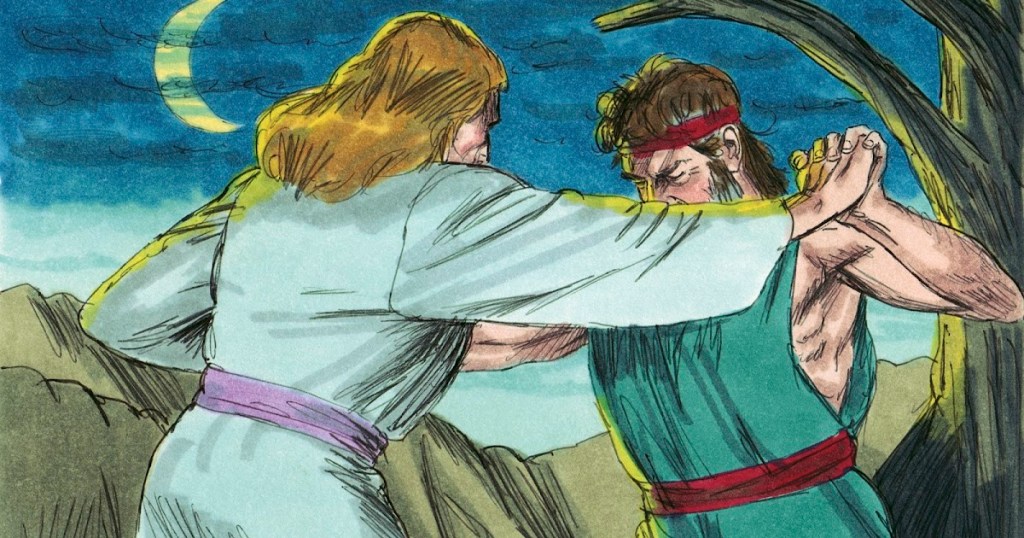
English translation found below
La vida de Yaakov Avinu no fue fácil, aún en el vientre materno y a la hora del nacimiento luchó por obtener su lugar en el mundo, por eso nació agarrado al talón de su hermano Esav, acción de la cuál obtuvo su nombre “Yaakov”: el que toma por el talón. Lo vemos luego luchando por obtener la primogenitura, saliendo de su casa solo, hacia lo desconocido, sufriendo los engaños y artimañas de su suegro malvado, y en esta Parashá reencontrándose con la amenaza de exterminio por parte de Esav su hermano.
En un episodio misterioso de esta historia, Yaakov lucha contra un ángel al que dice: “no te dejaré ir hasta que me bendigas”, entonces el ángel pregunta por su nombre y se lo cambia por “Israel”, …”porque has luchado con seres espirituales y con los seres humanos y has vencido”…El Midrash explica que éste era el Sar(ángel príncipe) de Esav, y al cambiar su nombre este reconoció el mérito de las luchas de Yaakov y así reivindicó su derecho a todo lo que poseía. De este episodio Israel sale renco, herido en su muslo.
La lucha con el ángel tuvo lugar la víspera del temido reencuentro de Yaakov con su hermano Esav, quien había jurado matarlo y venía hacia él con un ejército de 400 hombres. Yaakov se preparó físicamente: envío mensajeros de paz, envió regalos, organizó a su familia y a su campamento en caso de un encuentro violento. Pero no se quedó allí, nuestro patriarca entendía que a cada lucha física la acompaña una espiritual, y entonces luchó primero con el ángel de Esav, obtuvo su bendición y solamente luego enfrentó exitosamente a su hermano, pacíficamente y sin confrontación.
Maasé avot simán labanim(las acciones de los padres son una señal para los hijos), y así Yaakov nos enseña que en la vida cada dificultad, cada lucha, cada proyecto y desafío, debe ir acompañado de nuestro esfuerzo físico y también de nuestro trabajo espiritual. Así como no es suficiente con rezar y tener fe, sino que se espera de nosotros acción, de igual forma, cuando solamente actuamos por nuestra fuerza pero ignoramos la guerra espiritual que se libra paralelamente, no estamos siendo eficientes ni equilibrados en nuestra lucha. Como dice el refrán popular: “A Dios rogando y con el mazo dando”; ambas cosas son necesarias para alcanzar un éxito que se convierta en bendición, ya que hay muchas victorias que terminan siendo una maldición para la vida, justamente porque se pelean solamente por uno de los flancos y el otro queda completamente vulnerable.
Merezcamos así recibir un nuevo nombre, aún si el precio es quedar renqueando por un tiempo. No en vano llevamos el nombre de Israel, no nos llamamos Am Abraham o Am Yitzjak, somos AM ISRAEL: los que luchan en el plano espiritual y físico, y así logran la victoria.
Shabat Shalom umevoraj!
Rab. Sem. Dr. Yaakov Rodriguez
Struggling to Achieve
The life of Yaakov Avinu was not easy. Even in his mother’s womb and at the moment of birth, he struggled to secure his place in the world. That is why he was born holding onto the heel of his brother Esav—an action from which he received his name “Yaakov,” meaning “the one who grasps the heel.” We later see him fighting to obtain the birthright, leaving his home alone into the unknown, suffering the deceit and schemes of his wicked father-in-law, and in this week’s Parashah facing once again the threat of extermination from his brother Esav.
In a mysterious episode of this story, Yaakov wrestles with an angel and says: “I will not let you go unless you bless me.” The angel then asks for his name and changes it to “Israel,” …“for you have struggled with spiritual beings and with human beings and have prevailed.” The Midrash explains that this was the Sar (prince-angel) of Esav, and by changing Yaakov’s name he acknowledged the merit of Yaakov’s struggles, thereby affirming his right to everything he possessed. From this encounter, Israel emerges limping, wounded in his thigh.
This struggle with the angel took place on the eve of the dreaded reunion with Esav, who had sworn to kill him and was approaching with an army of 400 men. Yaakov prepared himself physically: he sent messengers of peace, sent gifts, arranged his family and camp in case of a violent encounter. But he did not stop there. Our patriarch understood that every physical struggle is accompanied by a spiritual one. And so he first wrestled with Esav’s angel, obtained his blessing, and only then successfully faced his brother—peacefully and without confrontation.
Maasé avot simán labanim (the actions of the fathers are a sign for the children), and thus Yaakov teaches us that in life every difficulty, every struggle, every project and challenge must be accompanied by both our physical effort and our spiritual work. Just as prayer and faith alone are not enough—action is expected from us—in the same way, when we act only through our own strength while ignoring the parallel spiritual battle, we are neither efficient nor balanced in our struggle. As the popular saying goes: “Pray to God but keep swinging the hammer.” Both are necessary to achieve a success that becomes a blessing, for there are many victories that end up being a curse precisely because they are fought only from one flank while the other remains completely vulnerable.
May we merit receiving a new name, even if the price is to limp for a while. It is no coincidence that we carry the name Israel. We are not called Am Abraham or Am Yitzhak—we are Am Israel: those who struggle on both the spiritual and physical planes, and through this achieve victory.
Shabbat Shalom umevorach!
Rab. Sem. Dr. Yaakov Rodriguez
 Español
  English